You’ve explored a lot of different mediums and disciplines, from pieces that combine tempera, watercolor, graphite and image transfer to curating and running a DIY gallery space out of your family home. I would love to hear you describe your art practice in your own words.
There’s this term, “overseas Filipino worker.” That’s how a lot of Filipino people end up outside of the Philippines. I guess I think about that term and how I myself situate my work and my labor in relation to those two words “overseas” and “Filipino.”I have thought about my painting—not as overseas Filipino work because that means a really particular thing—but how I think about my [overall] practice. A lot of that has to do with thinking about water as a material that I work with that plays into migrant narratives and diasporic histories.art practice in your own words.
Can you tell us more about your painting practice?
I make these paintings with water based media that are liftable, so they don’t plasticize like acrylic. Once they dry, they remain open—liftable. So if you wet them again, they can be reactivated. It creates a lineage; a series of actions and decision-making that is open-ended. You can continuously go back into the painting, which means that you can continuously go back into these decisions, which means that the decisions that you made yesterday affect the thing that you’re doing now, and vice versa. The word I’ve been using is “consequences.” So I try to make consequential gestures when I paint, or I try to make paintings that are composed out of consequences and gestures. I relate that to the series of decisions and consequences that lead to the event of immigration and the condition of diaspora. I think at the heart of my practice are those sensibilities and concerns.

That’s really interesting because when you describe the consequences in the medium of water based painting, it feels very neutral. But of course, with immigration, a lot of consequences or causes aren’t neutral at all.
What are you currently working on?
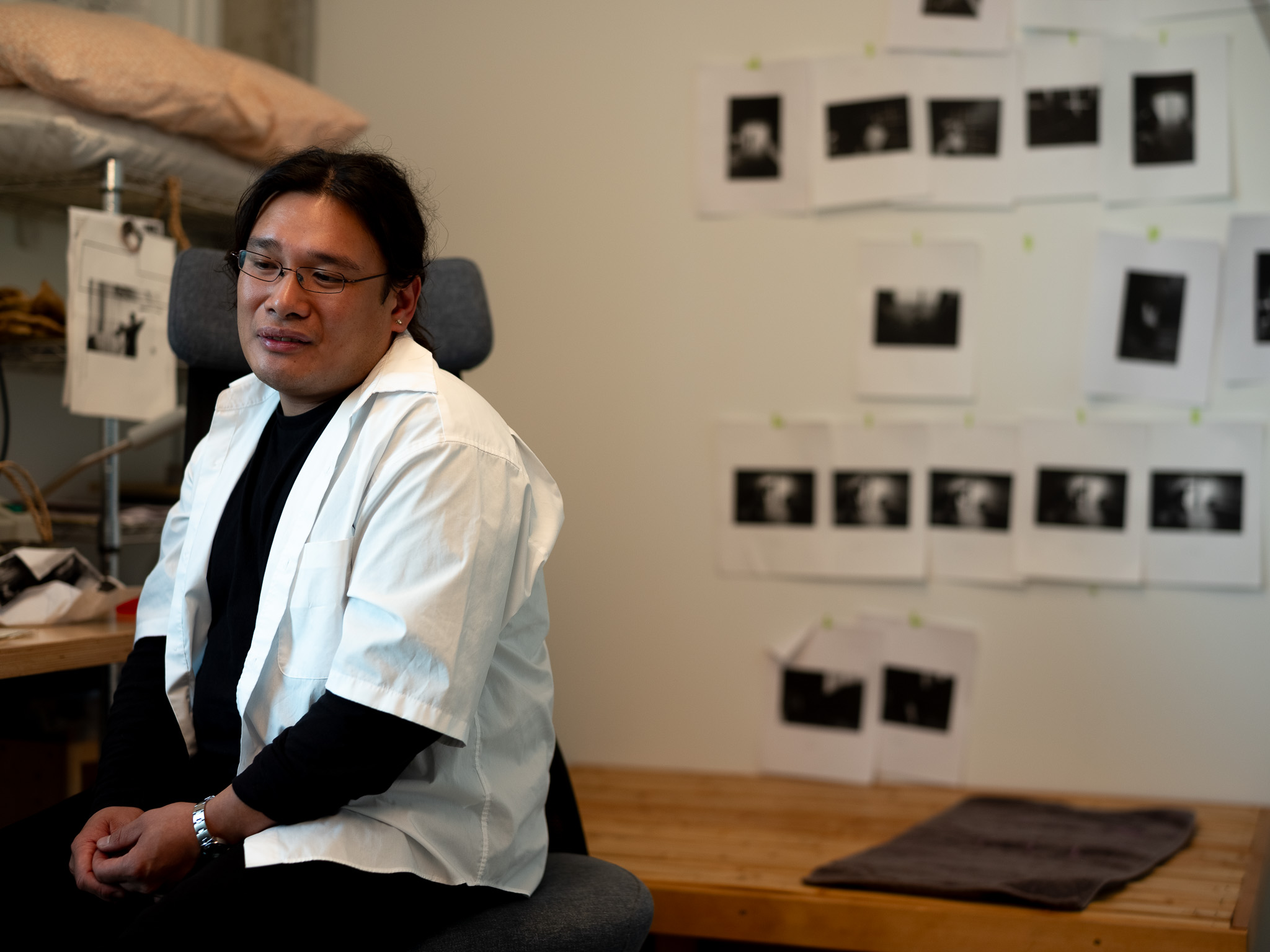
One of the things that I’ve been working on is a book; of images from a performance that my friend and collaborator [and 221A Building Technician] Kiyoshi Whitley and I did together in 2023. We performed it in this place called Boombox, which is a shipping container that was converted into a performance space by a group of artists and dancers. The performance thought through that site or that object of a shipping container and tried to imagine its histories, its life. We made this hour-long performance inhabiting that object and created a bunch of furniture for the audience to sit on. I would say it’s about blue collar labor, domesticities, and collaboration and that object as a site of all of those things.
Can you tell us more about your choice to move into printing and book-making as the medium for your current work?
The story begins with Jacquelyn Zong-Li Ross. She used to run Blank Cheque Press. Before I applied to the Fellowship, I knew she was getting rid of her printing equipment. We had known each other through the Capilano Review, and I had made books previously, so she was wondering if I would be interested. Then the Fellowship opportunity came about, and I had been wanting to get back into book-making. It’s been a while since I last made a book at that point. I’ve always liked the form of the book. It’s self-contained but really expansive. The proposition of binding your own books was interesting to me. So I guess part of it was circumstantial with Jacquie’s equipment, but also it’s kind of always been part of my practice. Certain things just make more sense in book form, you know? I’ve been thinking about this book that I’m working on with Kiyoshi as a cinematic object. That makes sense to me.

A lot of your work is collaborative, I noticed. Why is that important to you?
A big part of what I wanted to do in this Fellowship was to collaborate with other people, [especially] having the resources through the Fellowship to invite or even to pay the person who made these photos—who we weren’t able to pay previously. I think collaboration is important to me because…it feels natural. I’m around people and friends all the time, and a lot of them are artists. You end up having a lot of conversations around things that you could possibly make together, so I try to actualize those conversations. And also something like [this book], I would never make alone. Even the performance, for example, I wouldn’t have done that without Kiyoshi. And, yeah, it just makes art-making better. Makes it feel more fun. The moment of seeing what you come up with together and how far it is from the thing that you would make yourself, you can tell when you’re actually making something new, or making a third thing, I guess, when it’s you and another person.
What is something unexpected that emerged out of this project?
The book was unexpected. I don’t think it’s such a natural thing to make a performance into a book work. That also felt circumstantial. We couldn’t figure out how to take videos in that dark box [at Boombox]. So we got our friend, Natasha Katedralis, to take photos of us, and then kind of ended up with a mountain of them. We had all this material, so it felt like maybe a book could be a good use for it. I thought at one point that this was going to be a practice project. I was like, “Oh, we have all this content,” so I was like, “Yeah, I’ll practice. Maybe I’ll quickly make something with this.” But then it kind of ended up consuming the past 18 months.

How has being part of 221A’s fellowship, including having the studio space at 825 Pacific Street, impacted your art-making?
It’s significantly impacted my art making. All these projects specifically developed in this space. They activate a different part of my practice. I use the space to try and expand how I work, and exercise a little bit more agency, which I think is important to practice as an artist. I appreciate that there was an openness to the Fellowship. I’m excited and equally as surprised. I don’t think I would have expected to have made some of these things.
I find the space and items I surround myself with to help me art-make. I love my little nook with my armchair, or being able to have floor space and my little altar of trinkets and scavenged shells. What’s something that gives you energy and carries you throughout your practice?
I like that False Creek is right there and that I can access it so easily and walk down and look at the water. There’s also some banana trees over there that I visit.
I didn’t know we had banana trees.

Yeah, it was the first thing I did when I got here, chopped down a bunch of banana leaves from the waterfront and tried to make some pages. I don’t know, maybe I’ll put this in the Fellowship Library [laughs].
We’ll take it.
“Banana leaves from the start of Christian’s Fellowship, found somewhere over there.”
I’ll send you the pin.