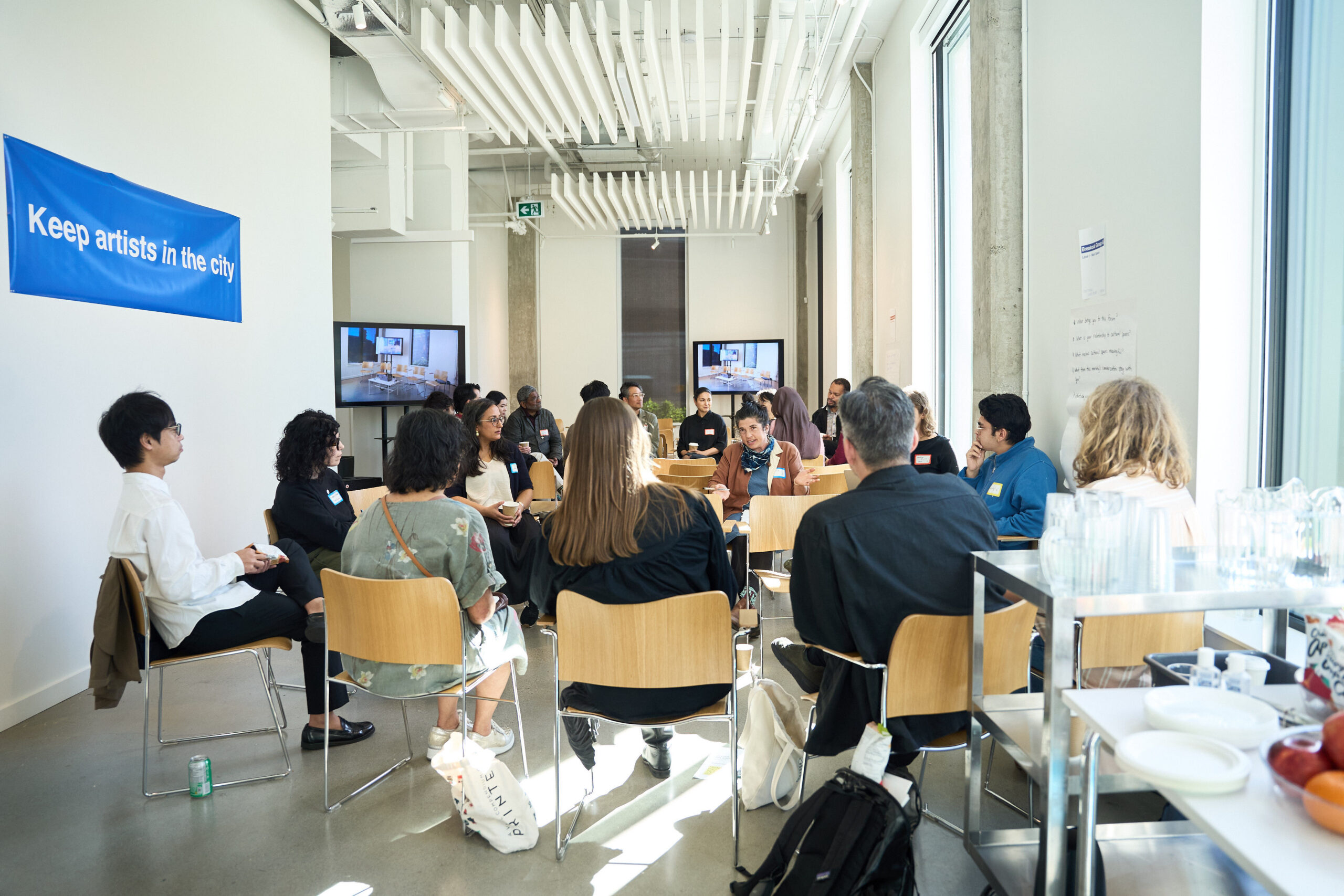
Cover photo: Forum participants engaged in breakout discussions about what makes cultural space meaningful and their relationship to cultural space. Photo by Kayla Isomura.
Opening doors to arts communities
For me, the CLT forum came to represent an “opening of the doors” of the Cultural Land Trust. After eight years of research, community engagement, and advocacy, we opened our doors to learn from artists and organizations across diverse disciplines and to share what we know.
As I talked with our guests, the severity of their experiences as arts and culture professionals and the urgent need for a broader infrastructure solution to protect the sector resonated heavily. In particular, panelists Alen Dominguez, Jim Carrico, Reza Nik and Sean Dennie emphasized the increasing precarity arts organizations face: volatile negotiations with private landlords that often lead to displacement; rising property tax levies that outpace or circumvent municipal measures intended to ease financial pressures on arts non-profits; venue closures and cancelled programming as a result of regulatory barriers and City enforcement; and disproportionate rental costs that leave organizations understaffed, overworked, and less able to serve their communities. These experiences speak to the interconnected challenges that are faced in the art sector, and the systemic flaws that prop them up. Listening to these day-to-day stories, I felt more and more convinced that a long-term solution that removes cultural space from the financialized markets for permanent, affordable arts use is critical.

Cultural Land Trust and Colonial Property
As a model with the capacity to upset the boundaries of dominant property relations, land trusts are often perceived as opaque and mystified, like any nascent movement or idea that contests the norm and seeks to subvert oppressive systems. A lot of this confusion has to do with language, and our broader capacity to define a problem. However, there is the property regime; as one of my favourite scholars Brenda Bhandar calls it, a racialized property regime that is becoming more and more difficult to ignore.
It’s the long-term implications of this racialized property regime that brings us together. Today, we face displacement and cultural loss due to escalating real estate prices and a system that favours the interests of private owners and corporations, that leans on unregulated market actors to achieve an economic balance. In this context, the community land trust model offers a subversive solution that can operate within the colonial structure that transforms land into commodity. When it comes to property, the truth underneath the truth is that property is in fact land. Any financial value associated within is contrived, invented, violently enforced, dispossessed, stolen; a bent of something more beautiful and profound than the security of “ownership” can ever offer.


Photos by Kayla Isomura.
Cultural Land Trust as Relational Practice
Where we start from at the CLT, and where we started from on the day of the forum: thinking about how to see and feel land as land-first, property second—or even better, last.
Our first two speakers of the day shared the responsibilities inherent to co-existing with the land and our relations, and the meaning of access to place. 221A Board Chair Nathan Grandjambe spoke of the many tributaries that make up each of our own confluences, the many waters that come together to make who we are. Our responsibility is to honour those connections and to show up among community with honesty and a sense of responsibility for how we actualize those parts of ourselves. When I listen to Nathan, I’m reminded to thoughtfully hold my many pasts and connections—my ancestors, the land, my kin, my personal diasporic journey—as the relations to whom I’m accountable.
χʷəy̓χʷiq̓tən / Audrey Siegl spoke of the importance of art-making and creative practice, and how integral access to spaces to make, gather and share can be for community but also for survival. She reminded me that cultural practice can be a simultaneous act of joy and resistance. Maybe joy is resistance.
I’ve always loved that “community land trusts” use the word “land” rather than “property”. It’s a continual reminder of our relations and responsibilities. Yet, its use can be somewhat unsettling. As a subversive model working within the property regime, it adopts many of the methods used in conventional or market real estate practices. I’m continuously weary of the risk of inadvertently recreating or reifying systems of exclusion and harm that property norms have constructed, especially when formulating collective ownership of land on stolen or systematically dispossessed lands.

The legacy of colonial property enforcement is felt to this day and can’t be ignored, as evidenced in the practice and thinking of our first set of panellists Kamala Todd and Camille Georgeson-Usher. These Indigenous women, both educators and artists, spoke to a common theme of holding land as relations while responding to the colonial realities of erasure and dispossession—and shaping new legacies of reclamation.
Drawing on their respective experiences in public art, planning, counter-mapping, and embodied thinking, Todd and Georgeson-Usher demonstrate how practice can reveal the ongoing effects of colonial property systems. Both panellists and their works underscore the damage and exclusionary ramifications of these systems and demonstrate the generative possibilities in opening our eyes to these realities and responding in a culturally, place-specific way. What struck me most during our dialogue was that it’s in these moments of responding to challenging truths and harmful legacies that new imaginaries emerge, and we can cultivate new solutions that become legacies of healing.
Likewise, I see land trusts as a generative response to colonial histories and the financialized present it has engendered. Norm Leech (Downtown East Side Land Trust, Frog Hollow Neighborhood House) reminded us that a Land Trust is more than a real estate model; it’s a way of organizing people in a relationship that centers interdependency, interconnectedness, and a responsibility to care for the land and each other. Questioning whether the land trust can be a solution in a financialized market, Norm asserted that it is an act of self defence against the cultural space crisis and the solution for our current moment that will most likely evolve in the future.

Coming away from the Forum, I’m left thinking about my responsibilities as a planner for the CLT—the responsibility to balance urgency with relationship-building. Artists and arts organizations urgently need permanent, affordable spaces, but our work must also move at the pace required to build genuine trust, centre tenant voices, and meaningfully involve communities in shaping the CLT’s governance and future. If the CLT is to challenge dominant property relations rather than reproduce their exclusions, the communities it seeks to serve cannot simply be consulted; they must be integral to its development.
Since moving to Vancouver, and especially since beginning this work, I’ve met so many thoughtful, creative, and inspiring practitioners whose knowledge continues to shape my understanding of what the CLT can become. Their voices remind me that cultural space is not simply a real estate concern and that the CLT need not be merely a mechanism for acquiring and managing property. At its best, it can be a relational practice: a way of organizing ourselves around land, community, and our responsibilities to one another. The Forum felt like an opening of the doors. My hope is that we keep them open and allow what enters to transform the work.
Project Support