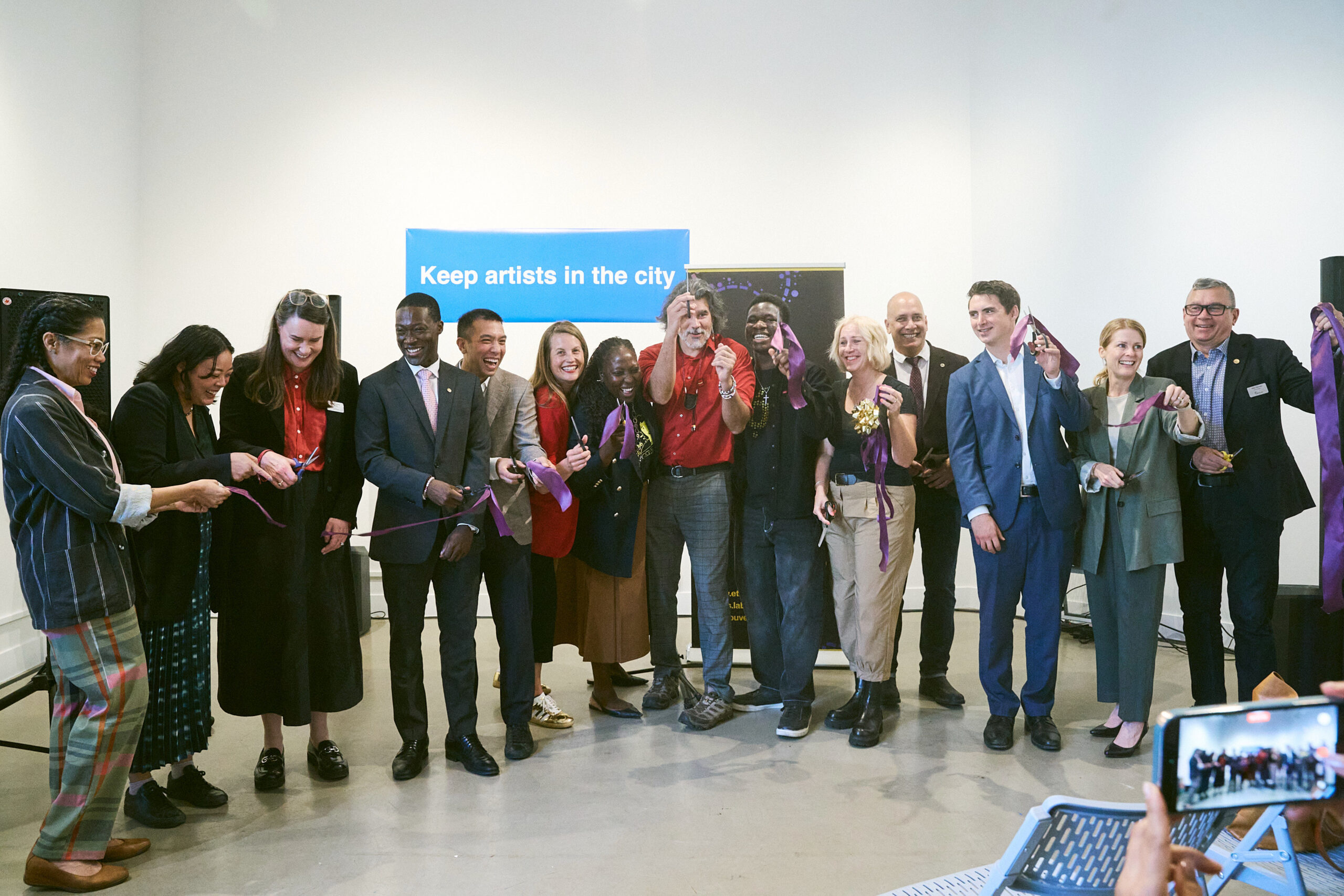
Cover Image: Ribbon-cutting for 221A and Ethọ́s Lab’s new Cultural Amenity Space at 177 East 3rd Avenue, September 11, 2026. Pictured: 221A Director of People & Equity Afuwa, 221A Director of Admin & Finance Michelle Fu, Councillor Lucy Maloney, MLA George Anderson, 221A Executive Director Brian McBay, MLA Christine Boyle, Ethọ́s Lab Executive Director Anthonia Ogundele, 221A Board Chair Nathan Grandjambe, Ethọ́s Lab Graduate Chibueze, Former Deputy Mayor Sarah Kirby-Yung, Mayor Pete Fry, MP Jake Sawatzky, Former Councillor Rebecca Bligh, Councillor Mike Klassen (left to right). Photo by Kayla Isomura.
A difficult year at City Hall
Vancouver’s 2026 “Zero Means Zero” budget, built to hold property taxes flat, required cuts across City operations. Cultural grants were held at current dollar levels, but after years of stagnant funding, they have not kept pace with rising costs. At the same time, the City’s arts and culture team has changed significantly. With long-time staff retiring and roles shuffled across social and cultural services, the City has lost much of the institutional knowledge and community relationships that connected it to the sector; along with the capacity to track how provincial and federal policy shifts land locally and to pursue new partnerships and funding opportunities. Many arts leaders spent 2025 feeling unheard at City Hall, in a city with the highest concentration of artists and cultural workers per capita of any major Canadian city.

Arts as Common Ground in Municipal Campaigns
Across the municipal campaign, the sector’s priorities found broad support. Six of the seven parties 221A reviewed made specific arts and culture commitments, and most converged on the same fixes: legal pathways for small and DIY venues, protection of existing space from displacement, and arm’s-length grant decisions through an independent arts council. Several also committed to increasing or stabilizing arts funding. In Mark Busse’s CreativeMornings/Vancouver candidate survey, candidates from nearly every party echoed these ideas. 221A is calling on the new council to turn that common ground into action, including rebuilding the City’s arts and culture staffing capacity.

Next steps for the Cultural Land Trust
In July, City Council unanimously passed the motion “Keep the Artists in: Creating a Cultural Land Trust for Vancouver,” directing staff to report back by the end of Q1 2027 on a framework for an arm’s-length nonprofit trust. Vancouver has lost more than 400,000 square feet of artist studio space since the 2010s. A land trust holds buildings permanently for cultural use, outside the speculative market, so rents can be set at what artists can afford. 221A ran the feasibility work and is advancing the Cultural Land Trust as its fiscal sponsor, and every party at September’s arts forum backed its expansion.
Support in principle is a start, but a trust needs property and capital to exist. When the staff framework returns, 221A is calling on the new council to make two founding commitments: transfer the City’s interest in 825 Pacific Street and other properties to the trust as its founding portfolio, and contribute capital in the range of $15 million. Seeding the trust with City assets allows it to secure space from day one, and gives federal, provincial and philanthropic partners a concrete commitment to match.
Provincial housing legislation has reshaped how cities fund amenities. Density bonusing and community amenity contributions, long a key source of cultural space in Vancouver, are giving way to a new amenity cost charge framework; it can fund cultural facilities, but only if councils choose to prioritize them. 221A will urge the new council to name culture explicitly in its amenity strategy so arts spaces aren’t left competing with every other public need.
Preparing for Pressure at the Provincial Level
The arts are core to social cohesion and democratic expression in our communities. The election of a new provincial government brings real uncertainty for the arts sector. The 2026 BC Budget, released in February, already projected cuts to the Ministry of Tourism, Arts, Culture and Sport of $2 million in 2026/27 and $8 million in each of 2027/28 and 2028/29, including about $3.5 million from BC Arts Council. A new government with its own fiscal priorities may revisit those numbers, and the BC Arts Council, already stretched, could face further pressure.

The incoming government has signalled the repealing of the Declaration on the Rights of Indigenous Peoples Act (DRIPA), Sexual Orientation and Gender Identity (SOGI 123), and more broadly, immigrant and newcomer supports and equity, diversity and inclusion programs. These frameworks shape much of how cultural work happens in BC, from the decades-in-the-making re-balancing of granting streams to Indigenous-led cultural initiatives. For 221A, upholding the self-determination of Indigenous Nations, Peoples, and communities is inseparable from our cultural space work, and that commitment does not change with a change in government.
According to Statistics Canada, 95.9% of Canada’s population growth in 2022 came from “international migration to help fulfill employment needs across the country and the program created to welcome people fleeing the Russian invasion of Ukraine.”. For generations, BC has been known for its shared prosperity of intercultural belonging. We stand firmly opposed to those who seek to restrict the meaningful inclusion and representation of newcomer, minoritized and historically excluded communities. We call on all people and institutions to stand together against hate during this unprecedented time.
221A’s vision is for a pluralistic society in which all people have the means to access and make culture. 221A will seek early, constructive engagement with the new BC government and the incoming minister responsible for arts and culture. We will also work closely with our sector partners and opposition parties to weather what comes next and advocate strongly for stable BC Arts Council funding as Budget 2027 takes shape. The arts give voice to people who do not have a seat at the table.