Since 2018, 221A has led research, feasibility analysis, and sector consultation to answer one pressing, practical question: How do we keep artists in Vancouver? With an estimate of more than 400,000 square feet of artist workspace lost in Vancouver over the past decade[1], the Cultural Land Trust (CLT) emerged as a solution to address the increasing displacement of artists and arts and cultural spaces.
During the meeting, local artists and community members, including Rath Art Supplies and the Museum of Vancouver, spoke in support of the motion. Speakers shared their experiences of precarity, loss, and displacement across local arts spaces, and 221A is grateful for their belief in the Cultural Land Trust as an infrastructural model for long-term stability and affordability.
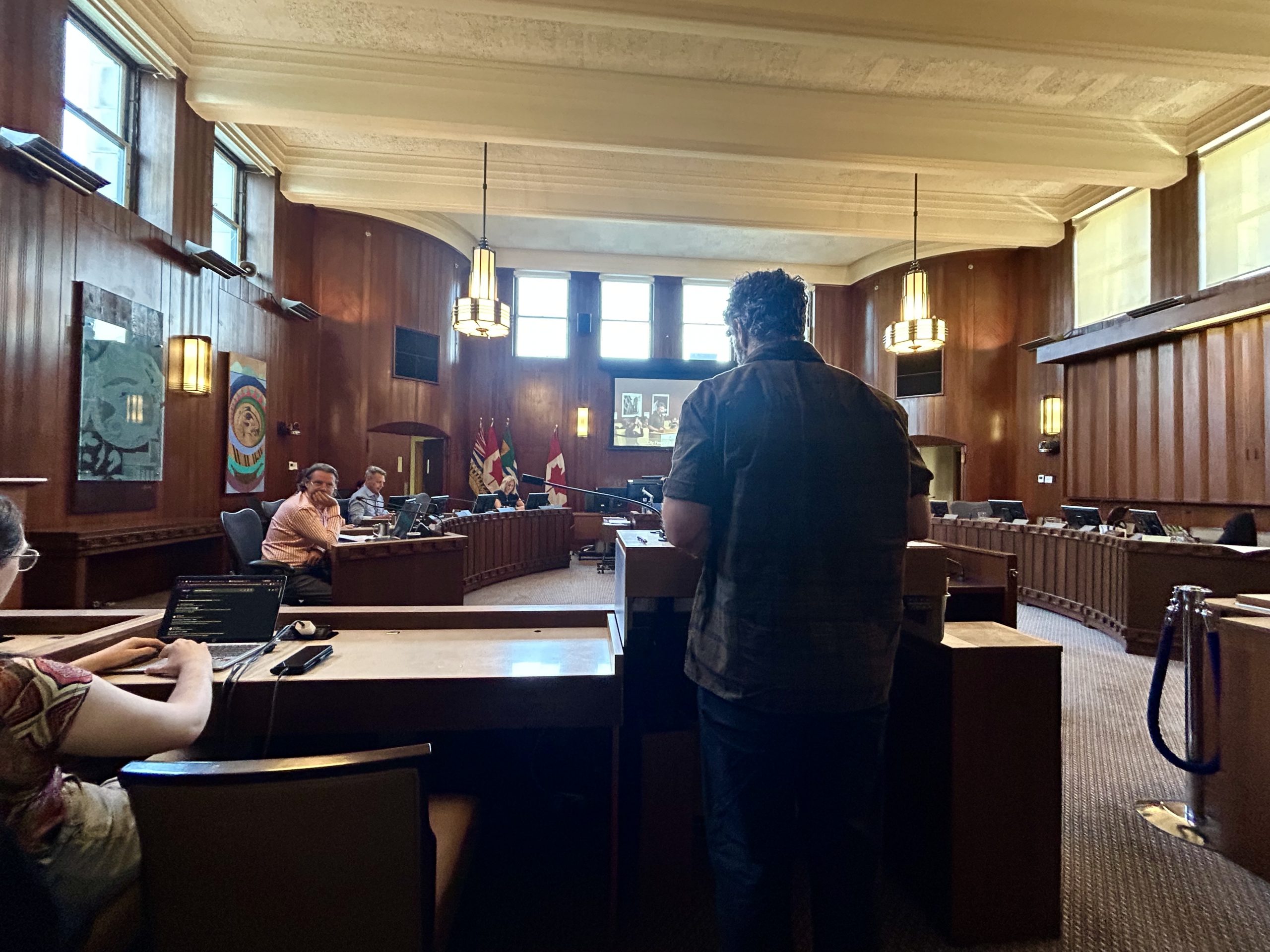
Video recording of Brian McBay, Co-founder and Executive Director of 221A speaking in support of the motion “Keep the Artists in: Creating a Cultural Land Trust for Vancouver” at City of Vancouver Select Standing Committee on Finance and Services on July 15, 2026.
Submitted by Councillor Sean Orr, the motion formalizes municipal support for the Cultural Land Trust after eight years of research. It puts into action the development of a framework for partnership with the city and a portfolio of potential city-owned buildings by March 2027. The version amended by Councillor Peter Meiszner, and then passed, includes affirmation that city-owned property considered for the CLT will generally utilize long-term leases to retain public ownership of civic lands and buildings.
“Rather than supporting one building at a time, [the Cultural Land Trust] creates a permanent capital platform that enables small and medium-sized arts organizations to access ownership opportunities that would otherwise remain out of reach,” presented 221A Executive Director Brian McBay.
The Land Trust model for artists has been applied successfully in Helsinki through Kaapeli, London through the Creative Land Trust, and San Francisco through the Community Arts Stabilization Trust and the Artists Spaces Trust.
A Cultural Land Trust, adapted to Vancouver’s unique context, has the potential to allow arts organizations to focus on delivering cultural programming while the Land Trust undertakes asset acquisition, long-term stewardship, capital planning, and portfolio management. It is also an opportunity to explore approaches to Indigenous rights recognition and reciprocity as part of the research conducted by the CLT has included decolonial frameworks like financial reciprocity and self-determined space use.
221A thanks City of Vancouver Mayor Ken Sim and Councillors Rebecca Bligh, Lisa Dominato, Pete Fry, Sarah Kirby-Yung, Mike Klassen, Lucy Maloney, Pete Meiszner, Brian Montague, Sean Orr, and Lenny Zhou for their unanimous vote of support.
221A gratefully acknowledges the Pinkerton Estate for gifting the Cultural Land Trust with its first property and the support of the Co-operative Housing Federation of BC, alongside the City of Vancouver, Province of BC through the BC Arts Council, Canadian Heritage, Canada Mortgage and Housing Corporation, the Real Estate Foundation of BC, and Inspirit Foundation, who have provided critical research, feasibility, and sector consultation funding since 2018.
Visit culturallandtrust.ca to learn more, and follow Cultural Land Trust on Instagram (@culturallandtrust) and LinkedIn for updates. The Cultural Land Trust is a member of the Canadian Network of Community Land Trusts.
Cover Image: 221A Head of Strategy, Jesse McKee, speaks at July 15 City Finance and Services meeting.
[1] From A City Without Art? No Net Loss, Plus!, a 2019 report by the Eastside Arts Society.