Looking at your portfolio, you’ve created so many different pieces over the years in a lot of different mediums–everything from music, to fashion, to production to hosting a retail sale. I would love to start by hearing how you would describe your art practice in your own words.
Yeah, it takes so many different shapes because it feels very circumstantial and responsive. I always try to use the tools that make sense for the idea, and sometimes it needs a bunch of different iterations. With P.L.U.R.O.M.A., it’s a runway show, but there’s a material aspect of the clothes, there’s video, there’s production, many different aspects. Sometimes it’s this desire in me to have as many different entry points as possible, so I end up trying out these ideas in different materials and mediums and forms. Sometimes it’s a bit too many options where I’m trying to cover all of the ground, but [mostly], it’s liberating because I’m not bound by any one material. It’s like world-building for some projects. Some things just don’t make sense as a photograph. They make sense as a song, or as a community project. That’s the reason that it’s so interdisciplinary.
Have you found similar themes that you’re exploring across different mediums?
Yeah, definitely. In the moment, it always feels like a brand new idea [laughs], but when I look back at my previous work, I can see a thread that goes through. Lately I’ve been dealing conceptually with this broad idea of spirit and spirituality–not necessarily in a religious sense, but in this sense of collective connection and connection to a more grand timeline. [I’m interested in] how that [connection] is intercepted or suppressed by the bureaucratic and administrative structure and logic that are often there to make things efficient and ordered. [This] context we’re living in [is] so oppressive because administrative interfaces are supposed to be kind of invisible, but I can’t see anything but that.
Lately, my performances have had a lot of guitar in them. I just like having a loud guitar in a gallery space because it’s almost painful. I like what a feeding back guitar and a distorted guitar do because it’s so visceral. I’m used to playing in a band or with other people where, even if you’re a noise band, there’s some kind of harmony between you and the other players. You’re often playing venues that are often acoustically treated. Playing in a gallery is just a different experience. I’m not trying to make it unpleasant, but this level of discomfort is how I feel operating in a bureaucratic world. I feel viscerally repulsed. But with the guitar, I can see more clearly a spiritual connection with other people [and others] who have played guitar, so that’s why I choose it.

So much of your work has gathered people in performances and spaces. Can you speak to what motivates that?
I feel very, very lucky to be able to make art. Sharing those opportunities with other people not only brings me joy, but it also just feels like the natural thing to do. It just seems like a no-brainer. With Liquidation World, it was a low barrier space for people to make art or [experiment], to share their art or do a weird show or whatever. It is a lot of work, but I’ve been in Vancouver for so long that I have people who trust me with space, which is also another very fortunate thing. If people let me use space and believe in me to organize in spaces, then I will.
With something like Liquidation World, the most rewarding thing is seeing people come to a show, and then come to another one, and then maybe submit something, and seeing them get involved and show up for other people in the community. That’s the biggest reward for doing anything that has people involved.
When I saw the P.L.U.R.O.M.A. show at Red Gate, it was so fun! You could definitely see all the different personalities of each artist. Even within different pieces created by the same artists, you could tell they were really experimenting and playing.
What are you currently working on during your fellowship? How does it continue or divert from your previous work?
I often do things that are multimedia, so for this Fellowship project, I’m challenging myself to see if I can say it all with just video. I’m taking this idea that I’ve sketched out as a big production performance and trying to translate that into just a film. [For] a lot of my projects, I do a performance, or there’s this element of liveness to it. It’s always been this necessary part of an artwork that activates it–for me more than for the audience. I feel like I need some kind of energetic exchange with the audience in order for me to feel like I’ve done everything I can to do justice to this work. But [in this film], I’m less on display in it. I’m trying to see if the work can stand on its own.
It ties into the other work that I’ve been doing during my Fellowship with P.L.U.R.O.M.A. and with the Western Front show. There’s repeating characters and repeating concepts. In P.L.U.R.O.M.A., the work took the shape of this huge production, and it was very much about the spectacle. And then, the Western Front show was more about the retail element. The security guard [as] a character took different forms in those two works, but I’m carrying that character forward to take a more serious look at it. Not that the other two weren’t serious, but they were more playful, and I’m [now] looking at more of the violent side of it.

How has being a part of the 221A fellowship impacted your art practice?
The open-ended [nature] of it has allowed me to be like, “Oh, I’m gonna do a performance. No, no, I’m gonna do an exhibition. No, never mind. I’m doing a film.” It’s cool because a lot of the time, these opportunities have [strict] deliverables. And while this is a project, I also think of it as more of a philosophical thing, like what do I want to say as an artist? I really appreciate that element of it. It has let me think with more longevity.
What have you learned about what you want to do as an artist?
I have learned that I need to do something more than just point at something and be like, “This is so fucked.” That’s not enough anymore. I need to be like, “Okay, this is fucked, but then how do we get out of that?” I’ve realized that’s the very base level of what my duty as an artist is. Dealing with a lot of these concepts that I’ve discussed, there’s so much to point at. You can point endlessly, but then [you need] to transcend or transform [them].

Is there an object or a part of your studio that you especially like, that brings you energy?
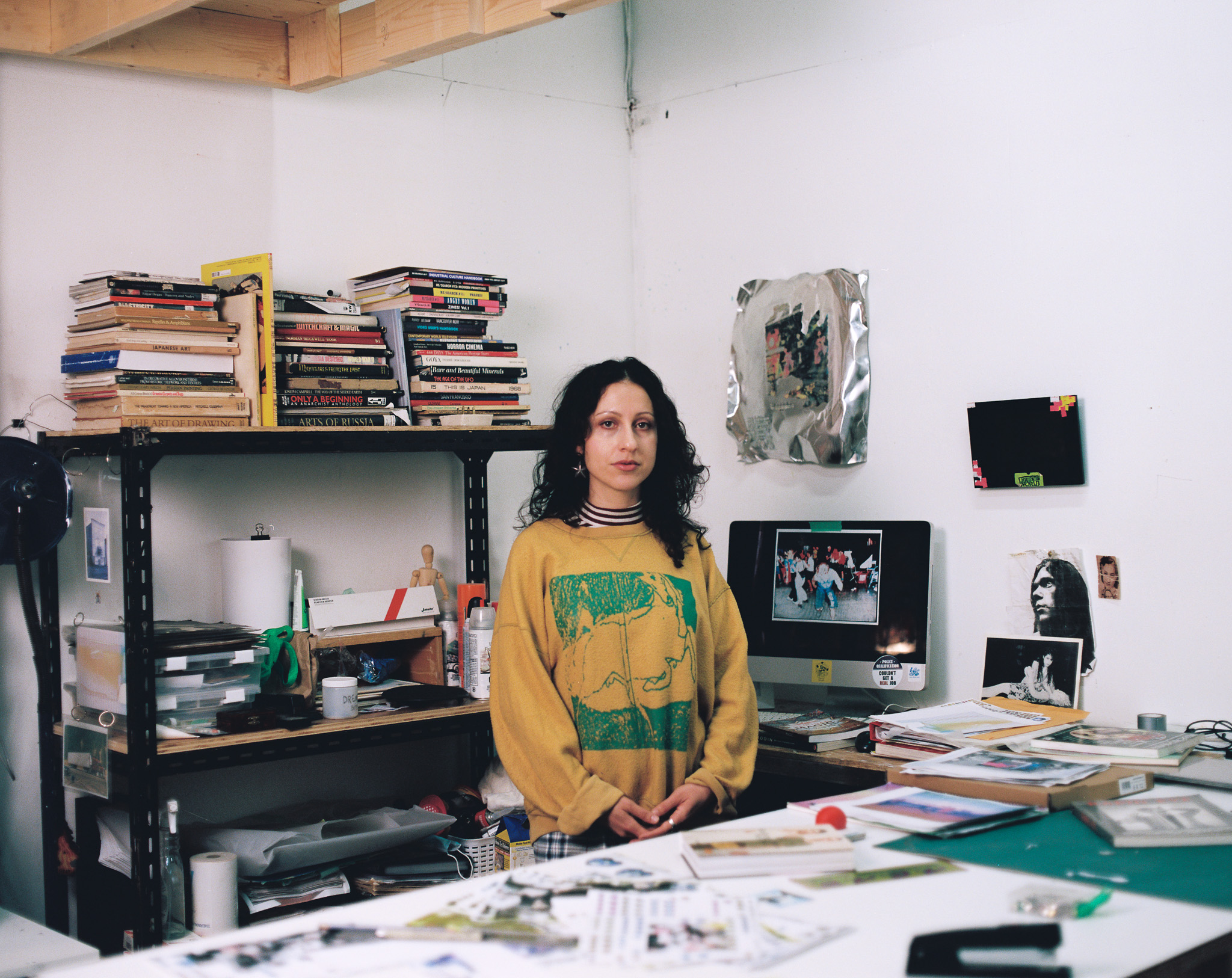
The stapler [laughs].
[Laughs] I know you’ve been holding it the whole time. I love it.
I’m drawn to it. I do a lot of paper stuff, so that does make sense. I staple things to the wall. This stapler is actually not the best because it doesn’t open. I wanted to staple something to the wall today but I couldn’t.
My last question is a bonus one if you want to speak to it. Is being a new parent shaping how you think about your art differently?
Yeah, I guess, what I said to the last question: my art has to do more than just point to the absurdity of the world. It’s been seven weeks, so I feel like I haven’t fully come to terms with what it means to be a mother. But I think [it’s] this desire to not make art just for myself, to make art for other people to be able to transform. I have a person now, and I can see their perspective changing day to day, and I have a part in that. Not to say that I don’t want to deal with the negativity of the world anymore. I want to more than ever, but I want to also find exit points.
That really speaks to how you describe your art as world-building–and now you’re a big part of building your seven-week-old baby’s world. Thank you so much for doing this seven weeks out.
Yeah, no problem.