I would love to start by hearing you describe your art practice in your own words.
My practice mostly involves figures. I do portraiture and figurative painting. I’m Blackfoot, a member of Kainai Nation (Blood Tribe). My mom’s from the Blood Tribe in Southern Alberta (Treaty 7), and my dad’s from Fort McKay First Nation in Northern Alberta (Treaty 8). I grew up in between in Treaty Six, right in the middle of both places.
All the figures in my work are Indigenous, and my main medium is oil painting. When I started my practice, it was a way for me to get to know other Indigenous people in the communities that I was a part of. I was really interested in what sort of signifiers are related to Indigeneity from an outside, non-Indigenous perspective, and then what things signify Indigeneity to us within our own communities. I like thinking about those things and how Indigenous people are presented in art, art history, and visual culture, and playing into that a little bit [while] also just showing what Indigeneity looks like to me–the everydayness of it.
Looking at your past works, I notice that a lot of it explores this tension between Indigenous representation and caricature. Could you speak more to that?
Mhm. A few years ago, I created a series of red paintings. I was thinking about how the colour red is attached to Indigeneity. I was really inspired by Kerry James Marshall’s work. He talks about the colour black in relation to Blackness. He created all these different shades of black and talked about the richness that is within the colour black. So, I was thinking about my own work and Indigeneity and how it relates to the colour red. I was interested in this idea of playing into caricature in those red paintings to see what it felt like. It’s an interesting thing for me to think about, and it does relate to the imagery of Indigeneity that I was used to seeing, growing up–just the little glimpses of caricature in Disney movies or something like that.

How are you approaching these questions in your current work? Are you exploring new methods of portrayal?
I really think a lot about painting and what the paint can do, what can be surprising in the act of painting, and not forcing my ideas of what Indigeneity looks like too much.
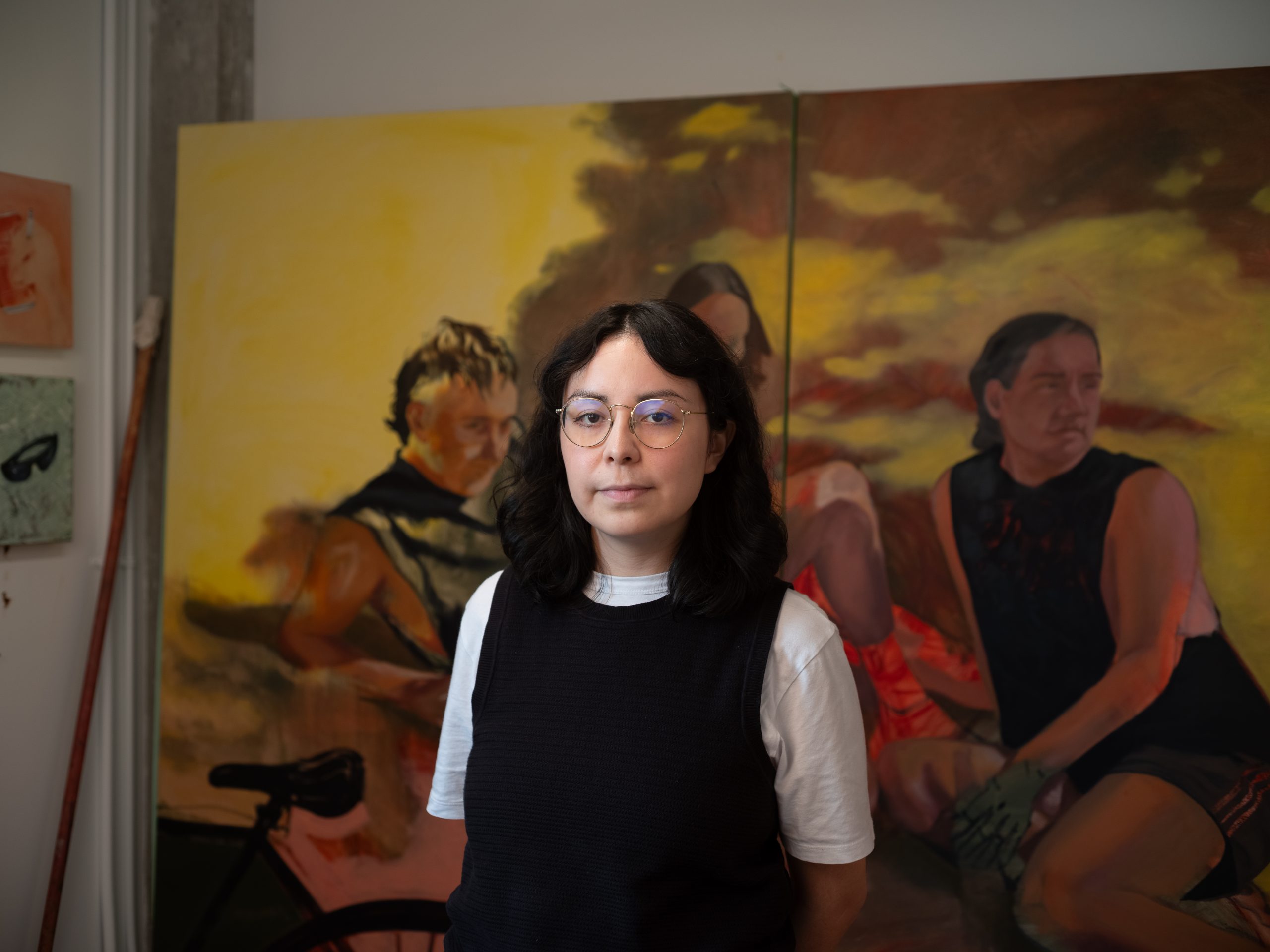
A lot of the work comes from photography. I take a lot of photos on my phone or on digital or film cameras. A lot of them are just natural photos of my family and friends, and then some of them are more staged. Right now, I’m thinking about these moments. A lot of times when [my family] gathers, we gather in times of mourning. So, I was thinking about this time when me and my family got together, and we were swimming. We ended up having this pool to ourselves, and it was really nice, and everybody was laughing and having a good time. I was just thinking about this hour in time and about how painting is sort of a way to extend the life of a moment. With [what] I’m working on right now, I wanted to think about those joyful or calm moments that [are] nice to hang on to. In terms of representing Indigeneity, I don’t want to go too much in a direction of feeling too sorrowful all the time. I like to balance these feelings of mourning and celebration, and the different sides of our lives.

I’m looking at the painting behind you, and I noticed that everyone’s in very relaxed positions. The expressions feel very at peace, and the undertone colours are very…content, so I definitely see that.
How do you approach your relationships with your portrait sitters?
Something early on in my practice that I wanted to think about was this relationship [between] myself and the sitter, and I didn’t want to impose so much of myself onto them, but I think that’s just a part of what naturally happens in the process of creating a portrait. Early on, I never wanted to ask anyone to come dressed up a certain way. I never wanted to play into signifiers of Indigeneity that people are used to, or [into] how people want us to present ourselves. So, it was always very casual. I try not to force anything too much, and I just want people to come as they are. That’s always been central to creating these portraits.
I was just at the National Portrait Gallery in London, so I was looking at a lot of the portraits. In history, you could get your portrait painted if you were wealthy or important in some way. Removing those hierarchical parts of portrait painting was important for me. I end up painting who’s around me and who I spend time with, like my family and friends and just people I meet.

How has it been being a part of 221A’s fellowship and having the studio space at 825 Pacific Street?
It’s been really really helpful. I finished my MFA at the end of 2023. Shortly after that, I was able to be a part of this Fellowship. Having a space in Vancouver to just work on stuff is really important and really rare too. I feel really grateful to have had this time because it allowed me to just, at the very least, have some time to breathe and think about the work that I want to create and experiment a little bit. It can be hard sometimes because you have to take on so much work, and then your practice falls to the bottom of the priority list. This Fellowship really allowed me to put my practice at the top of that list. I made a lot of work in the studio. I was able to make the portraits and make work for a few different shows. I spent a lot of time in here, and I’m definitely gonna miss coming here.
Yeah, I find having the space to do work is so important to me. I also love having little items that make my space. What’s something in your studio–space or object–that gives you energy and carries you throughout your practice?
I guess, my art books. I spend a lot of time looking at them. There’s a lot of things that are pretty important that I end up using everyday, but when I feel like I’m in a lull, I can always just look at my art books and gain inspiration or learn something.
I really like seeing all the jars that you’ve reused, especially seeing like, “Oh, you eat jarred peaches!” [Laughs] That’s sweet, seeing the little traces of your everyday life in those items.
Oh yeah [laughs], I end up bringing a lot of stuff from home, like the jars. Sometimes if something isn’t fitting at home, I tend to bring it to the studio, and then I just end up having a lot of stuff in here.
Studio spaces are nice little hoarding spaces, for the extra trinkets.