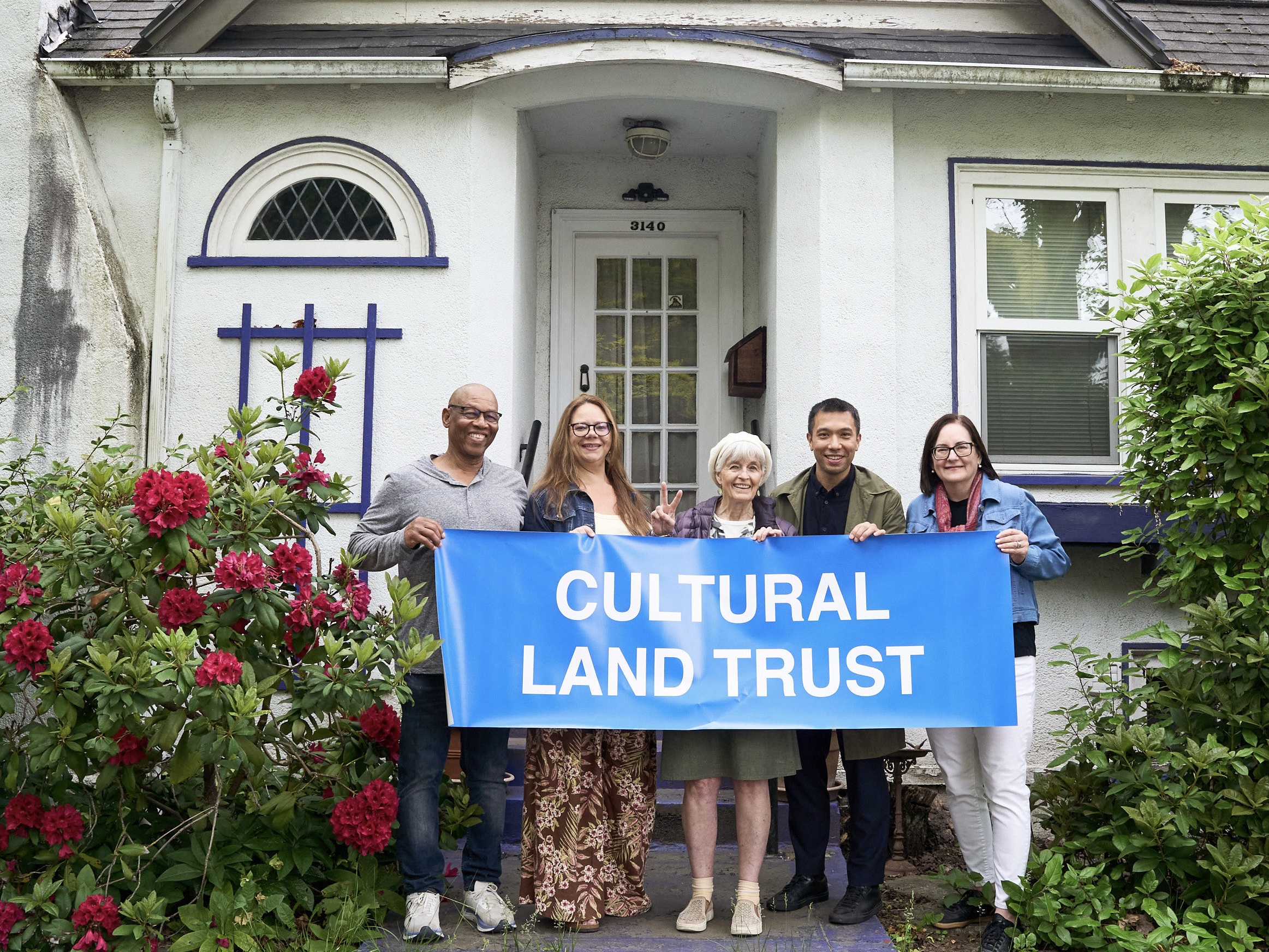
Cover Image: Francis Gibson (Natalie Wright’s husband), Natalie Wright (Evelyn Pinkerton’s stepdaughter), Tassillie Dent (Evelyn Pinkerton’s friend and executor), Brian McBay (221A Executive Director), and Monica Morgan (Community Land Trust Executive Director) pictured in front of the Pinkerton Estate house (left to right). Photo by Kayla Isomura.
Located near xʷməm̓qʷe:m (Camosun Bog) and Lord Byng Secondary School, the bequest was made possible through the Co-operative Housing Federation of BC and 221A. The house was gifted from the Pinkerton Estate of the late SFU professor, Dr. Evelyn Pinkerton, known for her dedication to environmental advocacy and management. It launches the CLT as its first official asset, assessed at a value of $2.77 million (2025), and provides the invaluable opportunity to begin activating the CLT model and values in practice.
The Cultural Land Trust emerged to address the increasing precarity of artists’ material conditions and the closure and displacement of nonprofit arts spaces in a city with escalating real estate pressures. The Land Trust model has been applied successfully in the UK through the Creative Land Trust, and the US through the Community Arts Stabilization Trust and the Artists Spaces Trust. In 2021, the Cultural Land Trust was formally incorporated as an independent non-profit society in British Columbia, operating from unceded xʷməθkʷəy̓əm (Musqueam), Sḵwx̱wú7mesh (Squamish) and səlilwətaɬ (Tsleil-Waututh) territories. 221A will provide fiscal sponsorship and property services to the CLT during its startup phase, until it has reached governance and operational stabilization.
Rather than relying on market-driven solutions, and competitive and costly short-term rental, the Cultural Land Trust is rooted in frameworks developed by the greater community land trust movement, applied specifically to arts and culture:
- decommodifying land through collective ownership and stewardship,
- stewarding land for cultural use and maintaining resources for community benefit in perpetuity,
- encouraging collaborative investments across public, private, and philanthropic sectors, and
- advancing reconciliation and equity in governance and asset management.
In other words, the CLT aims to remove property from the speculative real estate market, dedicate space to artists and artist-run organizations, and redirect added value back to artists, our communities, and First Nations on whose territories the CLT operates. The model also explores an approach to Indigenous rights recognition and reciprocity, such as revenue sharing or compensation mechanisms, centering Indigenous artists and community members in the governance, staffing, and projects of the CLT, and transfer of long-term control of CLT properties to Indigenous communities. [1]
In her fields of maritime anthropology and environmental management, Dr. Pinkerton “combined common property theory with cultural and political ecology, transforming our understanding of co-management and collaborative stewardship of natural resources,” notes her colleague Dr. Rashid Sumaila. We are grateful for Dr. Pinkerton’s shared vision of community stewardship and for her significant contribution.
As a 1920s-era wood-frame home with aging infrastructure, the property first requires repairs and stabilization for safe occupancy and long-term use. 221A and the CLT currently intend on using the home for community housing for the arts, and anticipates working with multiple different non-profit arts and culture groups to maximize access to the space.
“Receiving the Pinkerton house is a momentous step for the CLT,” remarks 221A Head of Cultural Spaces R&D, Carmut Me. “This meaningful donation will seed the growth of the CLT and actualize our goals of 30 buildings by 2050 for long-term cultural and housing stability. We are encouraged to see that the community is resonating with our vision and placing their trust in our work.”
“The Pinkerton house has a legacy of community housing and as a home for music and creative expression,” shares Monica Morgan, Community Land Trust BC Executive Director. “We are ecstatic to see this property become the catalyst for the creation of the Cultural Land Trust as they join the Community Land Trust movement in BC, alongside DTES Land Trust, False Creek South Community Housing Trust, Hogan’s Alley Society, and other land trusts forming across the country.”
221A gratefully acknowledges the gift of the Pinkerton Estate, the support of the Co-operative Housing Federation of BC, alongside the City of Vancouver, Province of BC through the BC Arts Council, Canadian Heritage, Canada Mortgage and Housing Corporation, the Real Estate Foundation of BC, and Inspirit Foundation who have provided critical research, feasibility, and sector consultation funding since 2018.
Stay tuned for upcoming stories about the property and CLT’s ongoing work. Visit culturallandtrust.ca to learn more, and follow Cultural Land Trust on Instagram (@culturallandtrust) and LinkedIn for updates. The Cultural Land Trust is a member of the Canadian Network of Community Land Trusts.
[1] Drawn from the introductory chapter, “What is a Land Trust?” of the upcoming Cultural Land Trust booklet, co-written by Darian Razdar and Miriam Berndt.
Project Support